
 We are spending a quiet Easter weekend at home. Tomorrow we are celebrating our wedding anniversary. Our daughter has invited us over for lunch. Her meals are always spectacular.
We had snow on Thursday and Friday. The forecast for tonight is mainly cloudy with 30 percent of flurries this evening. Clearing later tonight with the wind west at 20 km/h becoming light the is evening. The low is minus 9 with a wind chill of minus 16. Hopefully, spring will not keep us waiting too much longer.
Since most of my recent posts have been about health issues, I decided this would be different. Thanks to my son who purchased DNA kits for me from Ancestry.ca and from 23 and Me I have found family members I did not know existed and potential health risks I might have. I found the health information very interesting. I was adopted when I was six months old and the medical information noted that there was no VD or mental illness in my birth family.
According to 23 and Me I have inherited a small amount of DNA from my Neanderthal ancestors. Out of the 7,462 variants tested, they found 257 variants in my DNA that trace back to the Neanderthals. Altogether, my Neanderthal ancestry accounts for less than ~2 percent of your DNA.
I descend from a long line of female ancestors that can be traced back to eastern Africa over 150,000 years ago. These are the people of my maternal line, and my maternal haplogroup sheds light on their story.
My maternal haplogroup is K1b1b1. As my ancestors ventured out of eastern Africa, they branched off in diverse groups that crossed and recrossed the globe over tens of thousands of years. Some of their migrations can be traced through haplogroups, families of lineages that descend from a common ancestor. My maternal haplogroup can reveal the path followed by the women of my maternal line.
Haplogroup L: If every person living today could trace his or her maternal line back over thousands of generations, all of our lines would meet at a single woman who lived in eastern Africa between 150,000 and 200,000 years ago. Though she was one of perhaps thousands of women alive at the time, only the diverse branches of her haplogroup have survived to today. The story of my maternal line begins with her.
Haplogroup K1 is a relatively old branch of haplogroup K that traces back to a woman who lived approximately 22,000 years ago. She and her early descendants likely lived in the Middle East, where the K haplogroup traces its origins and continues to have a strong presence. Then, about 12,000 to 15,000 years ago, some women carrying K1 likely joined early migrations that moved west into Europe. The Ice Age was ending and temperate forests spread over the previously frigid continent. Human populations that had been blocked by massive ice sheets now expanded into the interior. Others came later, entering Europe with the spread of agriculture from the Middle East about 8,000 years ago. Today, members of K1 can be found throughout Europe, the Middle East, and even in Central Asia. My maternal haplogroup, K1b1b, traces back to a woman who lived approximately 11,000 years ago. Today K1b1b is relatively uncommon among 23andMe customers. Today, I share my haplogroup with all the maternal-line descendants of the common ancestor of K1b1b, including other 23andMe customers.
Mitochondrial DNA: Maternal playgroups are determined by sets of genetic variants in a tiny, unusual loop of DNA called Mitochondrial DNA (mtDNA). As the name suggests, mtDNA is found in the mitochondria, small but mighty structures inside our cells that turn fuel from the food we eat into energy.
Mitochondria evolved over billions of years from an independent bacterial cell that was engulfed by another cell. Instead of becoming lunch, the bacterium helped its new host use oxygen to produce energy. Over time it completely lost its independence and became an integrated part of the larger cell. (from 23 and Me).
Ötzi the Ice Man also belonged to haplogroup K. Ötzi the Iceman was discovered in 1991, protruding from a snow-bank high in the Alps near the Austrian-Italian border. His 5,300-year-old remains turned out to be so well preserved that researchers were able to construct a detailed account of his life and death. Chemical analysis of Ötzi’s teeth indicates he came from the Italian side of the Alps. He had suffered during the year before his death with whipworm, a stomach parasite that was found in his digestive tract. Yet he was fit enough to climb 6,500 feet in elevation during the day or two before he met his end in a rocky alpine hollow. Ötzi apparently was murdered, struck by a stone arrow point that was found lodged in his left shoulder. The twisted position of his body indicates that the murderer, or one of his accomplices, pulled the arrow’s shaft out of Ötzi’s prone body.
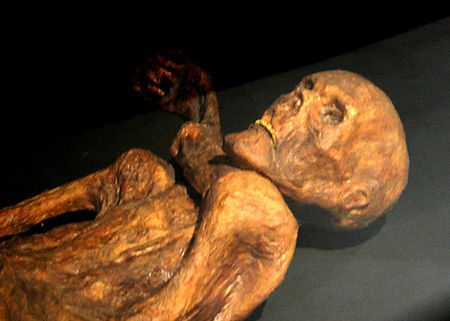 Yet whoever killed Ötzi did not take the valuable and finely wrought copper axe that he carried with him — an indicator that at the age of 45, the Ice Man may have been a figure of some importance in his community. Recently, scientists who were able to extract DNA from Ötzi’s remains discovered that he belonged to haplogroup K, which reaches levels of 20 to 30% in present-day populations in the region. But Ötzi’s maternal line, which fell into the K1 family of haplogroup K, did not match any of the branches that are known today. His maternal line must have died out in the 5,300 years since Ötzi’s death. (from 23 and Me).


 Not Over Till The Fat Lady Sings