March 29, 2003

As of yesterday, I can order off the senior menu at a restaurant. I had forgotten about this little perk until my girlfriend called me on the 28th and asked me if I was ordering liver and onions for lunch. She reminded me of my newly acquired 55+ status and the propensity of seniors to order liver and onions.

Funny how what begins as a slow leisurely day can turn into a hectic one. I woke yesterday with a headache of about 5 on the pain scale. This was definitely an improvement from the day before. I spent the morning working on the details of the Ukrainian dance recital which will be held next weekend. At noon I met my husband for lunch and I did not have liver and onions. After lunch I went shopping for my grandson’s birthday gift. I think he will be quite pleased with the trampoline I picked out.

My daughter, son-in-law and grandson arrived about 6:30 PM with a gorgeous birthday cake. My daughter had made it – carrot cake. My parents and my sister and her husband stopped in as well. We spent a very enjoyable evening. 

This morning I awoke with another horrible headache. This is 7 days in a row and quite frankly I am getting annoyed. I am also annoyed that I am so exhausted today. Yes I realize that I am now 55+ but for crying out loud that shouldn’t debilitate me like this! I certainly would not consider myself overworked or over stressed yesterday. My housekeeper comes every Friday so it is not house work that causes this fatigue. It seems whenever I have a relatively good day I have to pay with at least three days of feeling like death warmed over.

I suppose now that I am 55+, the next time I see a doctor, I will probably be told that all my problems will go away if I start eating liver and onions.

Posted in Autoimmune disease | Leave a comment

March 17, 2003

 My Mammogram

Image

from SuperLaugh.com  –  Yes I had a mammogram today…….Why do you ask?

The Boob Poem

For years and years they told me,
Be careful of your breasts.
Don’t ever squeeze or bruise them.
And give them monthly tests.

So I heeded all their warnings,
And protected them by law.
Guarded them very carefully,
And I always wore my bra.

After 30 years of astute care,
My gyno, Dr. Pruitt,
Said I should get a Mammogram.
“O.K,” I said, “let’s do it.”

“Stand up here real close” she said,
(She got my boob in line),
“And tell me when it hurts,” she said,
“Ah yes! Right there, that’s fine.”

She stepped upon a pedal,
I could not believe my eyes!
A plastic plate came slamming down,
My hooter’s in a vise!

My skin was stretched and mangled,
From underneath my chin.
My poor boob was being squashed,
To Swedish Pancake thin.

Excruciating pain I felt,
Within it’s vise-like grip.
A prisoner in this vicious thing,
My poor defenseless tit!

“Take a deep breath” she said to me,
Who does she think she’s kidding?!?
My chest is mashed in her machine,
And woozy I am getting.

“There, that’s good,” I heard her say,
(The room was slowly swaying.)
Now, let’s have a go at the other one.”
Have mercy, I was praying.

It squeezed me from both up and down,
It squeezed me from both sides.
I’ll bet SHE’S never had this done,
To HER tender little hide.

Next time that they make me do this,
I will request a blindfold.
I have no wish to see again,
My knockers getting steam rolled.

If I had no problem when I came in,
I surely have one now.
If there had been a cyst in there,
It would have gone “ker-pow!”

This machine was created by a man,
Of this, I have no doubt.
I’d like to stick his you know whats in there,
And see how THEY come out.

Author Unknown

Posted in Autoimmune disease | Leave a comment

March 16, 2003

Today is March 16th and I have reached the limit of my patience. This has been an exceptionally difficult week for me. Quite frankly I may have found it so difficult because I have reached the end of what I can tolerate..

I am angry, discouraged, frustrated and no longer have a desire to keep up my commitments. My life has been pared down to the point where I have very few commitments but this week even those seem to overwhelm me.

At this point I do not think I am depressed but I do know that I am very angry. On April 3, 2003 it will be five years since I submitted to RAI. Five years from hell is the only way I can describe them. There is no relief in sight. Maybe my frustration and anger is a result of this nagging suspicion I have that I will have to live like this for the rest of my life.

It is becoming more and more difficult to keep these diaries up to date. After all how much kvetching can one person do? When I started these diaries in September, 2001, I had no idea that I would still be undiagnosed in March, 2003. Quite frankly, I have an overwhelming temptation to just call it quits.

My CT scan of the thorax and abdomen was on February 28th. No one has bothered to call me with the results. It would be nice to hear from someone even if the results were normal. However, when I really think about it, why would I even expect the courtesy of a phone call? There has been nothing courteous about my treatment in the last five years.

When I saw the Hustler on January 14th, 2003 he ordered a repeat of the 5HIAA test I had done in November, 2002. I had the test done that afternoon at the hospital.. Late January I received a phone call from the Hustler’s receptionist telling me that they needed my height and weight to determine the results of the test. A few days later I received another call from the same receptionist asking me if I had ever had problems with the lab at the hospital. I told her that the lab at the hospital had refused to do several of the blood tests that had been ordered by No Name. She then informed me that there seemed to be problems with my test results but that she would get back to me. It is now March 16th and I have not heard one word from the Hustler or his staff. No one has bothered to inform me of the results of the repeated 5HIAA test.

What is it about me that inspires this shoddy treatment by so called medical professionals? I realize that I am overweight and that I am not what I would consider attractive. Does this make a difference in one’s medical care? Is it because fat 54 year olds just don’t “turn them on”? Would my treatment be different if I was model slim, beautiful and vivacious? Is it because I am coherent, well spoken and knowledgeable and don’t meet their criteria that all 54 year olds must be dumb, menopausal hypochondriacs? I have come to the conclusion that I am being discriminated against by these so called medical professionals because I am a woman, I am fat, and I am 54. When I walk into their offices I don’t send a sensual message to their brains.

Who breeds these incompetent, arrogant, and discriminating individuals called doctor that I have had the misfortune to see?

Posted in Autoimmune disease | Leave a comment

February 28, 2003

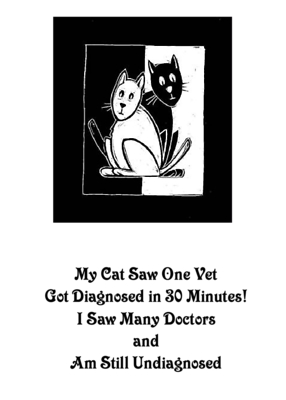
catsdiagnosedToday I finally had my long awaited CT scan. The appointment had been made in November, 2002 but because of our efficient medical system I was only able to have it done today. Please note I am being facetious. I had a CT scan of my thorax and a CT scan of my abdomen.

After the scan I asked the technician how long it would take before the results were ready. I was told between 7 and 10 days. I was also told that the results would be sent to the doctor who ordered the CT scan even though he had changed clinics. Quite frankly, I don’t think I will ever get the results of the scans. We will just wait and see if my hunch is correct. I guess I can always pay $25.00 and have the hospital send a copy of the results directly to me.

Our daughter was able to leave the hospital today on a weekend pass. We picked her up after my CT scan, took her out for dinner and then took her home.

Posted in Autoimmune disease | Leave a comment

February 21, 2003

The temperature outside is just too cold for this time of year. Hopefully it will begin to warm up in the next few days. I must get motivated and up date my website diaries. It is too easy to stay mired in this slump I am experiencing.

My daughter came to spend yesterday afternoon with me. I worked on the business books and she worked on her play. (I have remote access to the office so I can work on the books in the comfort of my den). My daughter’s intensity and concentration on research and writing should have given me warning signs but I ignored them. My son in law and grandson arrived after school/work and the three of them had dinner with us. They left our house for home around 6:30 PM. Again I should have been more observant and noticed that my daughter was insisting that they go home.

My son in law called at approximately 7:00 PM. I knew immediately that we had a problem. He informed me that my daughter had hurt herself shortly after they arrived home. Son in law told me that grandson did not know what happened and wanted grandson picked up as quickly as possible. Papa brought grandson back here and then he went into the city with son in law and daughter. Grandson had been told that mommy needed to go back to the hospital so he was upset when he got here. This illness and the subsequent hospitalizations are so difficult for an 8 year old boy. Grandson and I had a long talk about this illness and about hospitalization. It is hard to explain bipolar illness to an 8 year old. The hardest question to answer is “why does my mom have this illness?” I wish I knew the answer to that question. I have asked myself this over and over again.

After a 5 hour wait in the emergency department, my daughter was finally admitted. It is hard to imagine that someone who is mentally unstable and bleeding from numerous cuts is left to sit in the emergency waiting room for five hours before they are seen by a doctor. Such is the state of our medical system. Even after all these years, ten years to be exact, it is still difficult to come to terms with my daughter’s illness. My daughter was a vibrant young woman, involved in theatre and television since the age of 14, enrolled in her fifth year at university when this illness reared its ugly head. Life changed for her that December when she was admitted to hospital for six weeks.

Grandson spent the night and since there was no school today we could spend it together. We had lunch at my parents’ house, my usual Friday routine. After lunch I took him to the pool to swim. After swimming Grandson decided that he wanted a haircut. He not only got a haircut but had blue highlights put in his hair. Grandson thought he looked and I quote, “amazingly cool.”

Even though I am exhausted I have been able to keep up with what needs to be done. I find it incredible that I can keep pushing this body of mine no matter how horrible I feel and no matter how tired I am. There must be something to “mind over matter.” I made a silent promise to my grandson a long time ago. That promise was that no matter how I felt I would be there for him. He would never know that I was pushing myself beyond what I thought I could. This child does not need another disabled female in his life and I will do everything in my power to make sure that I will be a constant in his life.

Posted in Autoimmune disease | Leave a comment

February 14, 2003

Today is Valentine’s Day. My day turned out to be very memorable. It started off normally with me running around getting last minute stuff put away because my housekeeper always arrives by 8:30 AM on Fridays. Friday is also the day that I go to my parent’s house for lunch. Today my mom had quite a houseful which included my daughter, my son in law,and my grandson,

It was late afternoon when I got back home. I noticed some steaks thawing on the kitchen counter but did not pay much attention to them. I decided to lie down and read until my husband and grandson arrived home. My husband was taking our grandson to his hockey practice at 5:00 PM.

My husband and grandson arrived home just after 6:00 PM. Shortly after their arrival I was told to stay on the couch and to continue reading my book since dinner had been ordered in. I thought how lovely and continued reading. I did notice some weird shuffling around in the hall and kitchen but was too involved in my book to question it.

A short while later my grandson dressed in a sports jacket, shirt and tie with a towel over his arm entered the living room. He was carrying a silver tray. On the silver tray was a drink in a crystal goblet. A few minutes later Grandson returned but this time he was carrying a dozen red roses. At about this time I could no longer contain myself and said, “Oh my you are a sweetie pie.” Well, “the waiter” turned around and said, “Lady, you shouldn’t talk to waiters like that.”

I was served a salad, shrimp cocktail, stuffed baked potatoes and steak. For dessert I had a caramel apple pie with ice cream. Turns out dinner had not been ordered in. Papa did all the cooking and Grandson did all the serving. It was a wonderful surprise; one I will never forget.

My recovery from the skin infection I had is complete. Thank goodness I no longer look like Dumbo. I had to pick up a few things at the deli downtown while the ear and left side of my face were still swollen. I felt sorry for the poor clerk who asked me if she could help me. She took one look at my ear and let out this yell and then quickly recovered and apologized. I told her it was quite alright: I yelled every time I looked in the mirror.

We spent most of the weekend of February 8th and 9th at my grandson’s hockey tournament. Spending all day Saturday and all day Sunday entertaining 8 year old hockey players between games is quite an accomplishment.

My daughter, who is ill and often cannot attend her son’s hockey games, was able to attend the first game of the tournament. On the way to the tournament, Grandson announced that he would score the first goal of his first game in the tournament for his mother. His mom told him that when he scored he should turn around and point at her in the stands. He told her that would be embarrassing but that he would point at her from the bench. His team happened to play the first game of the tournament. To our amazement, this child scored the very first goal of the tournament and then promptly turned around and pointed to his mother. Two minutes later he scored the second goal in the tournament and again turned around and pointed at his mother. He went on to score 3 more times during that particular game. Amazing what sheer determination can do. The team went on to win the silver medal on Sunday.

What bothers me is that after a busy weekend like I just described I am a basket case for the rest of the week. I hate that. It seems as if I can only generate X amount of energy and once that is used up I need a week to generate enough to feel almost human again. If I was 94 I could understand this; but for crying out loud, this should not be happening at 54.

Posted in Autoimmune disease | Leave a comment

February 10, 2003

This morning the fatigue and exhaustion are overwhelming but the weekend was worth it. Papa and I are becoming hockey fanatics in our “old age.”

Grandson had a hockey tournament out of town this weekend. The five of us, including his mom and dad, drove down together on Saturday morning. During the drive, Grandson told his mom that he would score the first goal of the first game of the tournament for his mom. She told him that if he did, he should turn around and point his finger at her. Grandson informed his mom that pointing at her would be most embarrassing but that he would point to her from the bench.

His team happened to play the first game of the tournament and to our amazement Grandson scored the first two goals for his mom. The game had barely begun when he had a break away and scored the first one. Less than 3 minutes later grandson scored the second one. Each time he turned around on the ice and pointed at his mom; he didn’t wait until he got back to the bench. He went on to score three more times during the first game.

We spent all day Saturday and Sunday at the arena. The kids played very well and managed to win the Silver Medal. Grandson also won the Digger Award. I must say that the games this weekend were the most exciting hockey games I have ever seen.

Of course I crashed when I got home on Sunday evening but I expected that. As I mentioned earlier the weekend was well worth it. I refuse to let this ridiculous illness prevent me from enjoying my grandson and the activities he is involved in. If that means I have to hobble into an arena with my cane so be it. If that means I have to remain seated during an especially tense moment in a game so be it. I still have the ability to cheer. Thankfully my lips don’t experience the same level of fatigue as the rest of my body.

I woke up nauseous, dizzy and barely able to move this morning. The fatigue has burrowed into my bones and I can only shuffle. Banging into walls has become a daily morning routine, something I am getting quite accustomed to. The resulting bruises just add to my overall “pathetic” look. Even if I have to crawl on all fours for the rest of this week I will not let this illness prevent me from enjoying my darling Grandson.

Posted in Autoimmune disease | Leave a comment

February 5, 2003

It has been quite the week so far. I woke up on Sunday morning with a very painful left ear and a temperature. When I looked in the mirror I realized that the ear was swollen to twice its normal size and was very red. I figured that at the age of 54 I had come down with my very first ear infection. The ear became more painful and swollen as the day progressed. By late afternoon my neck was painful to touch.

When I woke up on Monday morning and looked in the mirror I was horrified to see that my ear was now three times its normal size and the redness had spread half way across my cheek and down my neck. That afternoon my husband took me to emergency at the country hospital. After checking my ear, the doctor told me that I did not have an ear infection but that I had a skin infection. He told me that the infection had also spread behind my ear and around back of my head. The doctor told me that the infection could have come from a small scratch in my ear; something I might not have been aware of. He prescribed antibiotics and told me if the infection did not clear up within a day and a half I would have to be admitted to hospital and put on IV antibiotics. Needless to say I was not impressed with my predicament. I have enough troubles; I don’t need something as bizarre as a skin infection and I don’t need to look like Dumbo.

When I woke up yesterday morning, the infection had spread a little bit closer to my eye. By evening I was really feeling miserable and wondering if it might be a good idea to go back to emergency. When I woke up this morning I was very pleased to see that the infection is no longer spreading. In fact, the hard lumpy area under the skin on my cheek is decreasing in size and the intense pressure is gone. It is no longer painful to touch. My ear no longer feels like it will blow up. Thank God for antibiotics.

This morning I received an email from Margot Russell, Demos Medical Publishing. She included a chapter from a book called “Life on Cripple Creek” and asked me to publicize it on my website. You can read the chapter here: Life On Cripple Creek. Even though Dean Kramer, the author, is a woman with a disability from multiple sclerosis, I think that all of us with disabilities can relate to her wonderful and poignant essay.

Posted in Autoimmune disease | Leave a comment

February 1, 2003

A friend/reader from Manitoba, Canada sent me the following this morning.  It needs no explanation.

Health Care.

Mr. Smith goes to the doctor’s office to collect his wife’s test results.  The lab technician says: “I’m sorry, sir, but there has been a bit of a mix-up – we have a proble m. When we sent the samples from your wife to the lab, the samples from another Mrs. Smith were sent as well and we are now uncertain which one is your wife’s. Frankly, it’s all either very bad or terrible!”

“What do you mean?” said Mr. Smith  “Well, one Mrs. Smith has tested positive for Alzheimer’s, and the other Mrs. Smith has tested positive for AIDS. We can’t tell which is which.”

“That’s terrible!” said Mr. Smith. “Can we do the test
over?”  “Normally, yes. But you have Manitoba Health Care, and they won’t pay for these expensive tests more than once”. “Well, what am I supposed to do now?” said Mr. Smith.

“Manitoba Health Care recommends that you drop your wife off in the middle of town. If she finds her way home, don’t sleep with her.”

Posted in Autoimmune disease | Leave a comment

January 31, 2003

Code of Conduct for Physicans – From the College of Physicans and Surgeons

** I have highlighted segments that have great significance to me.**

General Responsibilities:

1. Consider first the well-being of the patient.

2. Treat all patients with respect; do not exploit them for personal advantage.

3. Provide for appropriate care for your patient, including physical comfort and spiritual and psychosocial support, even when cure is no longer possible.

4. Practise the art and science of medicine competently and without impairment.

5. Engage in lifelong learning to maintain and improve your professional knowledge, skills and attitudes.

6. Recognize your limitations and the competence of others and when indicated, recommend that additional opinions and services be sought.

7. In providing medical service, do not discriminate against any patient on such grounds as age, gender, marital status, medical condition, national or ethnic origin, physical or mental disability, political affiliation, race, religion, sexual orientation, or socioeconomic status. This does not abrogate the physician’s right to refuse to accept a patient for legitimate reasons nor to confine practice to a specific condition or recognized field of clinical interest.

8. Inform your patient when your personal morality would influence the recommendation or practice of any medical procedure that the patient needs or wants.

9. Provide whatever appropriate assistance you can to any person with an urgent need for medical care.

10. Having accepted professional responsibility for a patient, continue to provide services until they are no longer required or wanted; until another suitable physician has assumed responsibility for the patient; or until the patient has been given adequate notice that you intend to terminate the relationship.

11. Limit treatment of yourself or members of your immediate family to minor or emergency services and only when another physician is not readily available; there should be no fee for such treatment.

Communication, Decision Making and Consent:

12. Provide your patients with the information alternatives, and advice* they need to make informed decisions about their medical care, and answer their questions to the best of your ability.

13. Make every reasonable effort to communicate with your patients in such a way that information exchanged is understood.

14. Ensure that information is available or has been provided to patients so that they know how to obtain care in your absence.

* new wording added by CPSM

15. Recommend only those diagnostic and therapeutic procedures that you consider to be beneficial to your patient or to others. If a procedure is recommended for the benefit of others, as for example in matters of public health, inform your patient of this fact and proceed only with explicit informed consent or where required by law.

16. Respect the right of a competent patient to accept or reject any medical care recommended.

17. Ascertain wherever possible and recognize your patient’s wishes about the initiation, continuation or cessation of life-sustaining treatment.

18. Respect the intentions of an incompetent patient as they were expressed (e.g. through an advance directive or proxy designation) before the patient became incompetent.

19. Treatments that offer no benefit and serve only to prolong the dying process should not be employed. When appropriate, an effort should be made to explain non-provision of futile treatments with patients and families.

20. When the intentions of an incompetent patient are unknown and when no appropriate proxy is available, render such treatment as you believe to be in accordance with the patient’s values or, if these are unknown, the patient’s best interests.

21. Respect your patient’s reasonable request for a second opinion from a physician of the patient’s choice.

22. Recognize the need to balance the developing competency of children and the role of families in medical decision-making.

23. Be considerate of the patient’s family and significant others and cooperate with them in the patient’s interest.

Confidentiality:

24. Respect the patient’s right to confidentiality except when this right conflicts with your responsibility to the law, or when the maintenance of confidentiality would result in a significant risk of substantial harm to others or to the patient if the patient is incompetent; in such cases, take all reasonable steps to inform the patient that confidentiality will be breached.

25. When acting on behalf of a third party, take reasonable steps to ensure that the patient understands the nature and extent of your responsibility to the third party.

26. Upon a patient’s request, provide the patient or a third party with a copy of his or her medical record, unless there is a compelling reason to believe that information contained in the record will result in substantial harm to the patient or others.

26.1 Duty to Warn when a patient threatens to cause serious harm to another person or persons and it is likely that the threat will be carried out, the physician must inform the appropriate authority or otherwise ensure that the threatened party is informed.

The Referral Process:

27. Definitions:
Primary care is the provision of health care services in response to a patient presenting with a need for any aspect of health care.

Continuing care is the provision of a plan of management for a patient which is developed in response to the individual’s specific health care needs and which changes as these needs vary over time. Except where concurrent therapy exists, there will be only one continuing care physician attending the patient.

The primary continuing care provider is the specific physician designated as being responsible for the patient’s continuing management (personal physician). In most situations this physician will be a family physician, although in some circumstances the role will be assumed by a specialist such as a paediatrician, gynaecologist, or internist. Except in emergencies, the personal physician or co-therapist shall be the referrer.

Non-physician providers may be the primary health care provider where no alternative exists or for a discrete area of health care. The term “discrete” means that the care is organ or body part specific and within the defined field of competence of a certified health care practitioner to provide primary continuing care.

27.1 Transfer of care occurs:

(a) when the role of the physician responsible for the ongoing management of the patient is terminated; when a new physician has accepted responsibility for continuing management of that patient.

There is an ethical obligation for the former to provide information necessary to the patient’s ongoing management.

(b) Another physician may be requested to assume responsibility for a specific program of treatment. At the conclusion of such treatment, a summary of the treatment provided will be given to the referrer if relevant.

27.2 Co-therapy is the provision of care by a second individual concurrent to the personal physician. A second physician may be involved in the care of a patient only with the knowledge and agreement of the personal physician.

27.2.1 A physician may continue treatment within the context of consultation.

27.2.2 A non-physician provider may administer an ongoing plan of management for the patient where the focus of the management is organ or disease specific and within the competency of the certified health care provider. Non-physician concurrent therapists should be known to the personal physician and report to that individual any findings or complications which may have significance relative to the patient’s overall well-being.

27.3 Consultation:
27.3.1 The consultant is any physician from whom a referrer seeks an opinion. The consultant may also be requested to assume treatment. The consultant need not be a specialist.

As referrer, you are the physician responsible for the care of the patient or may be a non-physician responsible for a discrete component of the patient’s health care who has specific need of a physician with specific training/expertise with regard to: (i) request for opinion and/or (ii) request to treat.

As referrer, you must provide the physician to whom the patient has been referred with all information which may help in the patient’s treatment and additional information the latter deems useful.

27.3.2 Request for Opinion
In a request for opinion, the referrer is limiting the consultant to the collection of data necessary to the rendering of an opinion to the referrer.

27.3.2.1 As the referrer, you must clearly state relevant information concerning the patient’s history and clinical findings, together with the question which is to be addressed.

27.3.2.2 As a consultant, you are acting in the capacity of advisor to the referrer and shall promptly provide the results of the consultation and the appropriate recommendations to the referrer, in writing.

27.3.2.3 Except in an emergency or 27.3.3, you may become the attending physician of a patient only upon the patient’s request or authorization.

27.3.3 Request for Opinion and to Treat
The referrer is asking the consultant not only for an opinion but also for treatment to be provided to the patient for the problem specified.

27.3.3.1 You shall address the issue raised by the referrer through history, examination, and investigation.

27.3.3.2 Collect whatever information is relevant to continuing management and advise the referring physician whether you are prepared to continue with treatment. If you agree to continue with treatment, it shall be confined to the specific problem presented. You will obtain additional consultations only when they are clearly indicated to assist or enable comprehensive management of the problem for which the patient was referred.

27.3.3.3 Should you find any unrelated problems, you will bring them to the attention of the referrer for action except where immediate action is clinically indicated or delay will cause the patient economic or physical or mental hardship. In the event of an exception, you will promptly inform the referrer of the circumstances.

27.3.3.4In the event of previously unrecognized need for mandatory reporting, you may complete the reporting or shall ensure that it is done by the referrer.

27.3.4 The consultant who accepts the role of a treating physician is acting as a concurrent therapist with the personal physician. In such a role the consultant should make reasonable effort to ensure that the family physician is kept informed regarding the patient’s progress and in the selection of additional consultants who may be required.

27.4 When you assume the care of a patient during the absence of the attending physician you must, on the availability of the latter, supply any information useful to continue treatment.

27.5 When providing patient services, ensure that you are clearly identified to the patient.

27.6 In an emergency, assist a colleague when the latter so requests.

27.7 Consider the patient’s preference in selection of a consultant.

27.8 Acknowledge a patient’s right to attend another health care provider.

Fees:

28. In determining professional or other fees to patients, consider both the nature of the service provided and the ability of the patient to pay.

29. Provide the patient with any explanation necessary for understanding the account.

30. Advise the patient in advance to the provision of services and/or any relevant billings:

30.1 that a service may be uninsured;

30.2 the specific terms and conditions relevant to payment;

30.3 any penalties for non-attendance or non-payment;

30.4 if payment will be required in advance of a requested, elective, uninsured service. In no other circumstances require payment in advance.

Responsibilities to Society:

31. When expressing medical opinions for public consumption you:

31.1 will first communicate to colleagues, through recognized scientific channels, the results of any medical research, in order that those colleagues may establish an opinion of its merits before they are presented to the public.

31.2 when informing the public about services, shall:

31.2.1 provide information which is factual, exact and verifiable;

31.2.2 not use superlative or comparative adjectives or descriptions regarding the quality of the services, products or personnel referred to in the advertising;

31.2.3 not use testimonials advocating for the personnel referred to in the advertisement;

31.2.4 not use unsuitable, false, misleading or deceptive information;

31.2.5 not promote one’s services in a pressing and/or repetitive manner. This is soliciting and is inappropriate.

32. Recognize that community, society and the environment are important factors in the health of individual patients.

33. Accept a share of the profession’s responsibility to society in matters relating to public health, health education, environmental protection, legislation affecting the health or well-being of the community, and the need for testimony at judicial proceedings.

34. Recognize the responsibility of physicians to promote fair access to health care resources.

35. Use health care resources prudently.

36. Refuse to participate in or support practices that violate basic human rights.

37. Recognize a responsibility to give the generally held opinions of the profession when interpreting scientific knowledge to the public; when presenting an opinion that is contrary to the generally held opinion of the profession, so indicate.

Responsibilities to the College:

38. When practising shall use only the professional name registered with the College and shall display such name prominently in office signage and exclusively in registries, advertising and telephone directories. An alternative name may be used only with the written approval of the College.

39. When reproducing the graphic symbol of the College for advertising purposes, must ensure that the reproduction is accurate and that the approval of the College is given for any use other than business cards/announcements.

40. Shall reply promptly in writing to any request from the College.

Responsibilities to the Profession:

41. Recognize that the self-regulation of the profession is a privilege and that each physician has a continuing responsibility to merit this privilege.

42. Teach and be taught.

43. Avoid impugning the reputation of colleagues for personal motives; however, report to the appropriate authority any unprofessional conduct by colleagues.

44. Be willing to participate in peer review of other physicians and to undergo review by your peers.

45. Enter into associations only if you can maintain your professional integrity.

46. Avoid promoting, as a member of the medical profession, any service (except your own) or product for personal gain.

47. Do not keep secret from colleagues the diagnostic or therapeutic agents and procedures that you employ.

48. Collaborate with other physicians and health professionals in the care of patients and the functioning and improvement of health services.

Responsibilities to Oneself:

49. Seek help from colleagues and appropriately qualified professionals for personal problems that adversely affect your service to patients, society or the profession.

Clinical Research:

50. Ensure that any research in which you participate is evaluated both scientifically and ethically, is approved by a responsible committee and is sufficiently planned and supervised that research subjects are unlikely to suffer disproportionate harm.

51. Inform the potential research subject, or proxy, about the purpose of the study, its source of funding, the nature and relative probability of harms and benefits, and the nature of your participation.

52. Before proceeding with the study, obtain the informed consent of the subject, or proxy, and advise prospective subjects that they have the right to decline or withdraw from the study at any time, without prejudice to their ongoing care.

Financial:

53. Do not enter any agreement where a reward, direct or indirect, is associated with the volume of your work, your referrals, your orders, or your fees.

54. Accept a gift of a substantial nature from a patient only after the patient has received independent financial and/or legal advice.

55. Avoid any inappropriate personal benefit in ordering drugs, appliances or diagnostic procedures from any facility in which you have a financial interest.

56. Refrain from accepting any unwarranted material benefit in the practise of your profession.

57. Refrain from obtaining an unwarranted material benefit for a patient.

58. Refrain from paying any form of rebate to a patient which is not generally available to the public and do not offer any material inducement other than competitive pricing.

59. For other clinical situations where appliances are indicated, the physician should provide a prescription so that the patient may obtain these appliances from the supplier of choice.

Posted in Autoimmune disease | Leave a comment